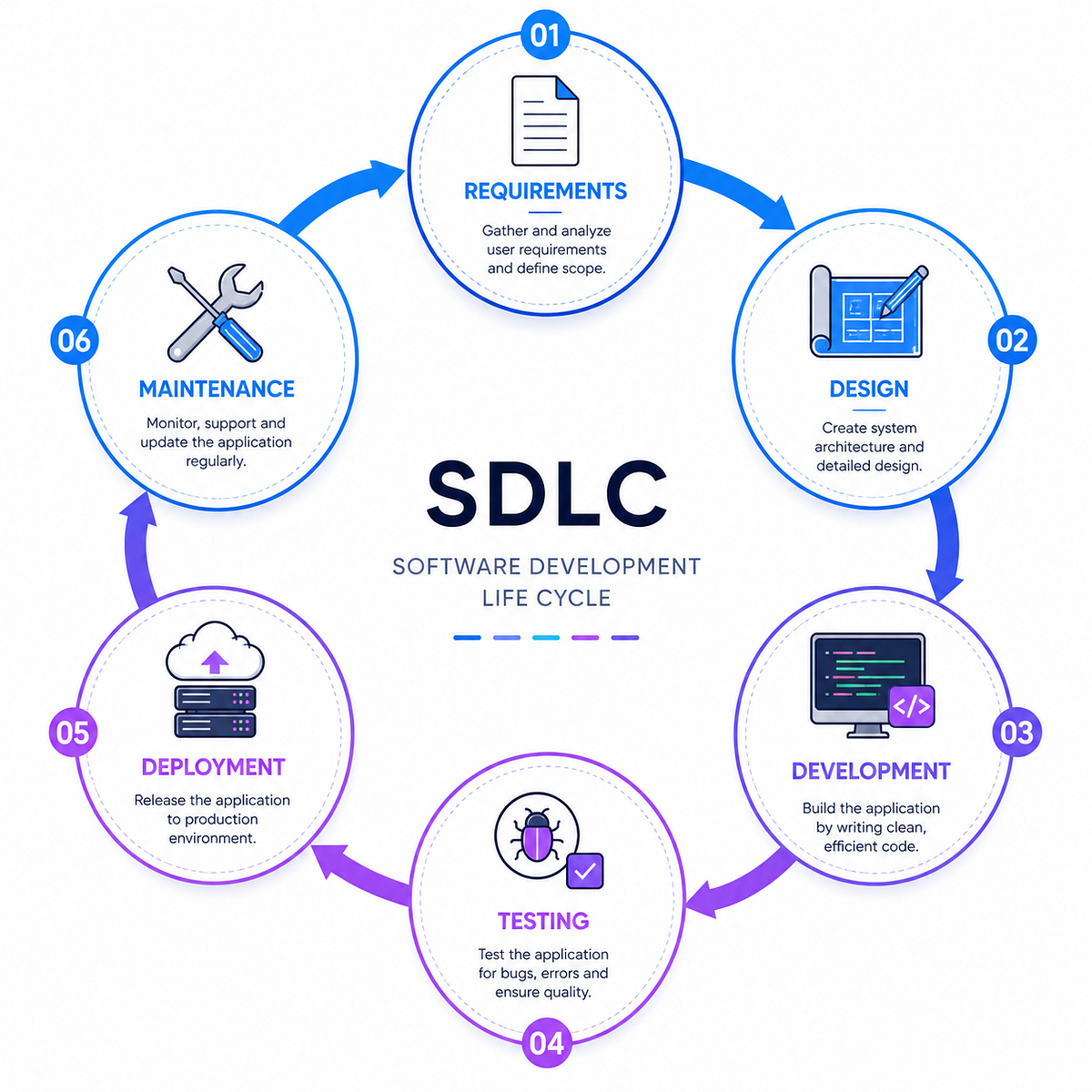
Software is already the engine that drives businesses today, from eCommerce applications to healthcare and even financial systems and applications based on Artificial Intelligence. However, building a well-oiled software product is far more complex than just writing a line of code – it also involves a thorough process that plans, implements, tests, and maintains every phase of development. This is where the software development life cycle (SDLC)comes into play. With growing demand from companies for higher-quality and faster software deliverables without security sacrifices, the Software Development Life Cycle is transformed into an overarching strategic concept for building reliable, secure, adaptable, and high-quality software.
The SDLC is an instrumental tool that aids development teams in risk management, collaborative efforts, cost estimation, and the production of software solutions that meet both organizational and customer expectations.
If you are launching the next startup in the tech space or updating aging software within a larger enterprise environment, learning about the software development life cycle is crucial to successful software development in 2026.
Quick Facts
- Organizations that follow a structured SDLC process often experience fewer development errors and smoother project delivery.
- Early testing during development significantly reduces the cost of fixing software defects.
- Modern Agile SDLC practices enable faster releases while maintaining software quality.
- Security is now integrated throughout the SDLC rather than being treated as the final step.
- AI-powered development tools are transforming how teams plan, test, and deploy software.
What Is the Software Development Life Cycle (SDLC)?
The Software Development Life Cycle (SDLC) is a systematic framework used to design, develop, test, deploy, and maintain software applications. Instead of approaching development as a series of disconnected tasks, SDLC divides the project into clearly defined phases that guide the team from the initial idea to long-term maintenance.
Think of SDLC as a roadmap. Every phase has specific objectives, deliverables, and quality checks, helping teams stay organized while minimizing costly mistakes.
A well-executed SDLC ensures that software is:
- Reliable
- Secure
- Scalable
- Cost-effective
- User-friendly
- Easy to maintain
For businesses, following a structured SDLC means fewer project delays, better collaboration between teams, and software that aligns with customer expectations.
Why SDLC Matters in 2026
Today's software must support multiple devices, integrate with cloud platforms, protect sensitive data, and adapt quickly to changing business needs. Without a structured development process, projects can easily suffer from missed deadlines, budget overruns, security vulnerabilities, and poor user experiences.
Implementing an effective Software Development Life Cycle helps organizations:
- Improve project planning and resource management.
- Deliver software faster without sacrificing quality.
- Reduce development costs by identifying issues early.
- Strengthen application security throughout the development process.
- Ensure software remains scalable as business requirements evolve.
- Enhance collaboration among developers, designers, testers, and stakeholders.
Simply put, SDLC transforms software development from a reactive process into a proactive strategy.
The Seven Phases of the Software Development Life Cycle
1. Planning
Every successful software project begins with careful planning.
During this phase, stakeholders define the project's objectives, business goals, budget, timeline, technical requirements, and potential risks. A clear roadmap helps prevent misunderstandings later in the development process.
Questions addressed during planning include:
- What problem will the software solve?
- Who are the target users?
- What features are essential?
- What technologies will be used?
- What is the expected project timeline?
Strong planning creates the foundation for every subsequent phase.
2. Requirements Analysis
Once planning is complete, the team gathers detailed functional and technical requirements.
Business analysts work closely with stakeholders to understand user expectations, workflows, integrations, and compliance needs.
This stage results in comprehensive documentation that serves as a reference throughout development.
Well-defined requirements significantly reduce scope changes and development delays.
3. Design
The design phase converts requirements into technical architecture.
Developers and designers determine:
- Software architecture
- Database structure
- User interface (UI)
- User experience (UX)
- APIs and integrations
- Security architecture
Creating detailed prototypes before development begins helps identify usability issues early.
If your organization needs expert assistance designing scalable applications, this is an excellent place to naturally reference your Custom Software Development Services.
4. Development
This is the phase where developers begin writing code based on approved designs and technical specifications.
Modern development teams often follow Agile methodologies, allowing software to be built incrementally while incorporating continuous feedback.
Key priorities include:
- Writing clean code
- Following coding standards
- Maintaining documentation
- Performing regular code reviews
- Version control management
A disciplined development approach improves long-term software maintainability.
5. Testing
Before software reaches users, it must undergo rigorous testing.
Testing ensures the application functions correctly while identifying bugs, security vulnerabilities, and performance issues.
Common testing types include:
- Functional testing
- Performance testing
- Security testing
- Compatibility testing
- Integration testing
- User Acceptance Testing (UAT)
Early and continuous testing helps minimize expensive post-launch fixes while improving overall software quality.
6. Deployment
Once testing is complete, the software is deployed to production.
Depending on project requirements, deployment may involve:
- Cloud environments
- On-premise infrastructure
- Hybrid systems
- Mobile app stores
Modern deployment strategies often include Continuous Integration and Continuous Deployment (CI/CD) pipelines to minimize downtime and accelerate releases.
Proper deployment planning ensures a smooth transition from development to production.
7. Maintenance
Software development doesn't end after launch.
Applications require ongoing:
- Performance monitoring
- Security updates
- Bug fixes
- Feature enhancements
- Compatibility updates
- User support
Regular maintenance ensures software remains secure, efficient, and aligned with evolving business needs.
Organizations that invest in continuous maintenance often achieve longer software lifecycles and better customer satisfaction.
Benefits of Following the SDLC
A structured Software Development Life Cycle provides measurable business advantages beyond simply delivering software.
Some of the most significant benefits include:
Improved Software Quality
Clearly defined processes reduce errors and improve application reliability.
Better Risk Management
Potential technical and business risks are identified early, reducing unexpected challenges later.
Stronger Security
Modern SDLC practices integrate security throughout development instead of treating it as a final checklist.
Higher Customer Satisfaction
Well-tested software delivers a smoother user experience, increasing customer trust and retention.
Reduced Development Costs
Fixing issues during planning or testing is significantly more affordable than correcting them after deployment.
Faster Time to Market
Agile workflows and automation help teams deliver high-quality software more efficiently.
How SDLC Supports Modern Business Growth
Businesses today rely on software to streamline operations, improve customer experiences, and drive innovation. A structured SDLC enables organizations to build solutions that are flexible enough to evolve with changing market demands.
Whether developing enterprise software, SaaS platforms, mobile applications, or AI-powered solutions, SDLC provides the framework needed to deliver consistent quality while supporting long-term scalability.
In the next section, we'll explore the most popular SDLC models, compare their strengths and limitations, discuss best practices, common mistakes to avoid, and examine future trends shaping software development in 2026.
Popular Software Development Life Cycle (SDLC) Models
Different software projects require different development approaches. Choosing the right SDLC model depends on factors such as project complexity, budget, timeline, customer involvement, and flexibility requirements.
1. Waterfall Model
The Waterfall Model follows a linear approach where each phase is completed before moving to the next. It works best for projects with clearly defined requirements and minimal expected changes.
Best for: Government projects, compliance-driven systems, and fixed-scope applications.
2. Agile Model
The Agile SDLC Model divides development into smaller iterations or sprints, allowing teams to deliver features continuously and respond quickly to changing requirements.
Best for: SaaS platforms, startups, mobile applications, and rapidly evolving business products.
3. Spiral Model
The Spiral Model combines iterative development with continuous risk assessment. Every cycle includes planning, risk analysis, development, and evaluation.
Best for: Large enterprise applications and high-risk software projects.
4. V-Model
The V-Model emphasizes testing alongside every development stage, ensuring quality assurance is integrated throughout the project.
Best for: Healthcare, banking, aerospace, and other quality-sensitive industries.
5. DevOps Model
Modern software teams increasingly adopt DevOps, which combines development and operations through automation, continuous integration (CI), continuous delivery (CD), and ongoing monitoring.
Best for: Cloud applications, enterprise software, and businesses requiring frequent releases.
SDLC Models Comparison
| SDLC Model | Flexibility | Speed | Risk Management | Best For |
|---|---|---|---|---|
| Waterfall | Low | Moderate | Moderate | Fixed-scope projects |
| Agile | High | Fast | High | Dynamic business applications |
| Spiral | High | Moderate | Excellent | Complex enterprise software |
| V-Model | Medium | Moderate | High | Quality-critical systems |
| DevOps | Very High | Very Fast | Excellent | Continuous software delivery |
No single model is universally perfect. The ideal choice depends on your project's objectives, team structure, and long-term business goals.
SDLC Best Practices for Modern Software Development
Following the right practices can significantly improve project outcomes regardless of the SDLC model you choose.
Define Clear Requirements
Unclear requirements often lead to delays, increased costs, and frequent revisions. Invest time in understanding business objectives before development begins.
Prioritize Security from Day One
Modern software development embraces DevSecOps, integrating security throughout every SDLC phase rather than treating it as a final checkpoint.
This includes:
- Secure coding standards
- Regular vulnerability assessments
- Penetration testing
- Data encryption
- Access control implementation
Automate Testing
Automation accelerates software delivery while reducing human error.
Automated testing helps validate:
- Functionality
- Performance
- Security
- Regression scenarios
- Cross-browser compatibility
Encourage Collaboration
Successful SDLC implementation depends on effective communication between developers, designers, testers, project managers, and stakeholders.
Collaborative tools and regular feedback sessions help identify issues early and keep projects aligned with business goals.
Monitor Performance After Deployment
Launching software is only the beginning. Continuous monitoring helps identify performance bottlenecks, security threats, and user experience improvements.
Businesses seeking long-term application success often benefit from professional Application Maintenance & Support Services.
Common SDLC Mistakes to Avoid
Even experienced development teams can encounter challenges if key practices are overlooked.
Avoid these common mistakes:
- Skipping requirement analysis
- Poor project planning
- Ignoring security until the final stages
- Limited communication between teams
- Inadequate software testing
- Poor documentation
- Choosing the wrong SDLC model
- Neglecting post-launch maintenance
Addressing these issues early helps reduce development risks and improves software quality.
SDLC Myths vs Reality
| Myth | Reality |
|---|---|
| SDLC is only for large enterprises. | Businesses of every size benefit from structured development processes. |
| Agile eliminates planning. | Agile encourages continuous planning throughout development. |
| Testing happens only after coding. | Modern SDLC promotes continuous testing across every phase. |
| Deployment marks the end of development. | Maintenance, updates, and monitoring are ongoing responsibilities. |
| Security is solely the testing team's job. | Security should be integrated throughout the entire SDLC. |
Emerging Trends Shaping SDLC in 2026
Software development continues to evolve rapidly. Several trends are reshaping how organizations approach the Software Development Life Cycle.
Artificial Intelligence in Development
AI-powered tools assist with code generation, bug detection, documentation, and testing, enabling faster development while improving productivity.
DevSecOps Adoption
Organizations increasingly integrate security into every development phase, reducing vulnerabilities before deployment.
Cloud-Native Development
Cloud platforms provide scalability, flexibility, and faster deployment pipelines, making them a preferred choice for modern software projects.
Low-Code and No-Code Platforms
Businesses are using low-code solutions for rapid application development while relying on traditional SDLC practices for complex enterprise systems.
Continuous Delivery
Automation enables frequent software releases with minimal downtime, helping organizations respond quickly to customer feedback and market changes.
Frequently Asked Questions
What is the primary purpose of the Software Development Life Cycle?
The Software Development Life Cycle (SDLC) provides a structured framework for planning, developing, testing, deploying, and maintaining software efficiently while reducing risks and improving quality.
Which SDLC model is best for startups?
The Agile Model is often the preferred choice because it supports rapid iterations, continuous customer feedback, and flexibility as business requirements evolve.
Why is testing important in SDLC?
Testing helps identify defects, improve software reliability, strengthen security, and ensure the application performs as expected before release.
How does SDLC improve software security?
Modern SDLC practices integrate security measures throughout development, including secure coding, vulnerability testing, access control, and continuous monitoring.
Can SDLC reduce software development costs?
Yes. Identifying issues during planning, design, or testing is significantly less expensive than fixing problems after deployment, making SDLC a cost-effective approach.
Key Takeaways
- Software Development Life Cycle (SDLC) provides a structured roadmap for building reliable software.
- Every phase—from planning to maintenance—plays a critical role in project success.
- Selecting the right SDLC model depends on project goals, complexity, and business requirements.
- Continuous testing, security integration, and collaboration improve software quality and reduce development risks.
- AI, automation, DevSecOps, and cloud-native development are shaping the future of SDLC.
Conclusion
As technology continues to evolve, businesses need software that is not only functional but also secure, scalable, and adaptable to changing user expectations. The Software Development Life Cycle (SDLC) provides the structure required to achieve these goals by guiding projects through well-defined phases, minimizing risks, and ensuring consistent quality.
Whether you're developing a customer-facing mobile app, an enterprise platform, or a cloud-based SaaS solution, following a disciplined SDLC approach helps deliver software that performs reliably and supports long-term business growth. By choosing the right development model, embracing automation, integrating security from the start, and committing to continuous improvement, organizations can build applications that remain competitive in 2026 and beyond.
A successful software project isn't measured solely by how quickly it's delivered—it's measured by how effectively it solves business challenges, delights users, and continues to create value long after launch. That's exactly what a well-executed Software Development Life Cycle is designed to achieve.